
Building Opportunity: A Conversation with Turner’s Darien Grant
By Robert Nelson - Published November 7, 2025

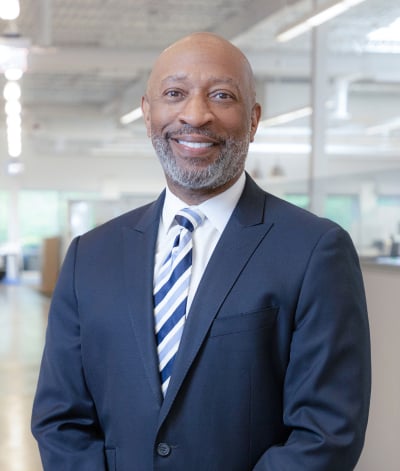
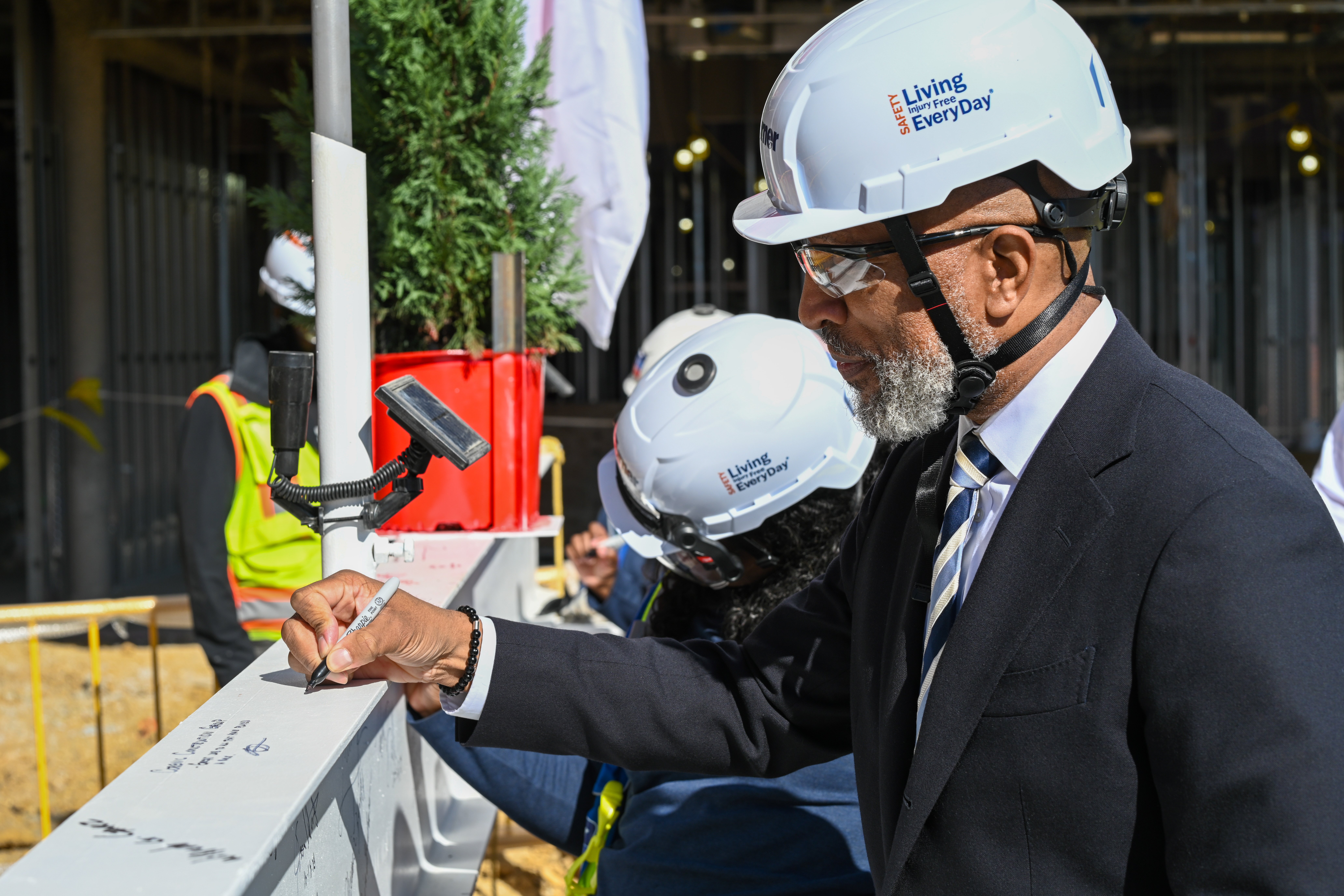

The Department of Capital Programs is proud to showcase the work of minority-led businesses and business owners who are playing a key role in developing new schools across the county. One such leader is Darien Grant, who has dedicated 36 years to Turner Construction, serving in a variety of leadership roles throughout his tenure. Turner Construction Company is one of the largest and most respected construction management firms in North America, known for delivering complex projects across many sectors. Darien currently serves as Vice President and General Manager of Turner’s Mid-Atlantic office, overseeing a diverse portfolio of projects including airport expansions, data centers, higher education, healthcare, interior modernization and K–12 school construction, including the new Suitland High School for Prince George’s County Public Schools.
Grant’s journey as a minority business leader in construction is both inspiring and impactful. His commitment extends beyond the projects he manages to fostering inclusion, mentorship, and opportunity within the industry. Recently, he joined the Department of Capital Programs for a conversation about his life, career, and his advice for the next generation entering the construction field.
Can you tell us about your background and what inspired your career in the construction industry?
I've had a lot of different roles within Turner, starting as a Field Engineer in 1989, Superintendent, Engineer, and Procurement Agent in our Houston office. Upon moving to the Mid-Atlantic area, I became a Project Manager before taking on the role of a Project Executive for about 10 years. I served as Turner’s Inclusion Officer for Turner from 2016 – 2019 then I became the General Manager for the Mid Atlantic office.
In terms of what inspired me. I always had a clear sense of direction of what I wanted to do. Growing up in the Bronx and seeing large buildings, always piqued my interest. I had an interest in the structures and how tall buildings were constructed. Going off to college, I considered my passion for music but ultimately was drawn to design and construction. At Norfolk State University, I received my associate’s in architecture and my bachelor's in construction technology.
What were some pivotal moments or decisions that accelerated your professional growth?
Early in my tenure with Turner, I contemplated attending law school or business school as a strategy to transition into business and leadership roles. Ultimately, I decided to attend law school, without the intention of practicing law. Having a heightened awareness for risk and understanding of complex contracts provided confidence as I interfaced with clients and with senior leaders within our organization.
Can you describe any notable obstacles faced during the early stages of your career?
When I looked around at the landscape of the construction industry in Texas, I didn't see many people who looked like me, so indeed, it posed a challenge, but it also posed an interesting opportunity to learn more about cultural dynamics. Once I got comfortable working with people of all nationalities and backgrounds, I began to grow professionally and personally. Getting to know people of all different cultures in a location with no family allowed me to appreciate that real value of diversity and inclusion at an early stage in my career.
You talked about your career in Texas. What made you transition from working there to Maryland?
I grew up on the east coast and graduated from Norfolk State University. Upon graduating, I was extended a job offer from Turner with a choice of numerous locations across America. To start my career, I wanted to go to a large city where I didn't have any connections or family ties so that I could focus on launching my career. I landed in Houston, Texas where I started my family. Having a family with young kids and extended family on the east coast, it was only a matter of timing and opportunity for me to request and transfer and move back to the east coast.
What is a project you’re most proud of?
I would say two. The first one would be a healthcare project for Hermann Hospital in Houston, Texas. I had the opportunity to build the hospital where my oldest son was born, that has significance for me. I tell people who come into Turner, within your first 10 years, you will work on a healthcare project …and every day for the rest of your life, you're going to be responsible for saving a life.
The other project was the MLK Jr. National Memorial. I had a sense of appreciation of the significance of the memorial while it was being built, but perhaps two years after it was completed, I was driving into the district early one morning, on Dr. King's birthday, I made that decision to stop and pay my respects to Dr. King at the Memorial. Arriving there at 6 o'clock in the morning, and almost 1000 people were at the site, of all different races, nationalities, gathered around the memorial, singing songs and hugging really put it in perspective for me, the significance of the project and me being a part of it.
"..as you ascend the ranks you recognize that it's not about you. It's really, truly not about Darien Grant. It's about the people that I work with and serve, so that I can provide support to develop their careers and make them more impactful players.."
As someone who has held many roles in their career, how has your leadership philosophy changed over time?
One thing has been foundational for me throughout my growth and leadership is the spirit of inclusion for people. As I mentioned earlier, working with a very diverse group of people in Houston and now here in the Mid Atlantic has been a privilege. For me, inclusion has always been a staple, being able to work with people of all cultures. Inclusion is making sure you respect everyone, but not at the expense of anyone.
In terms of how it has changed, as you ascend the ranks you recognize that it's not about you. It's really, truly not about Darien Grant. It's about the people that I work with and serve, so that I can provide support to develop their careers and make them more impactful players at Turner, and for people outside of the organization. You look at the subcontractor community, making sure they are all set up for success, the larger businesses, and the small business community, to make sure they're set up for success. My impact has expanded, and I take every opportunity I can to use my platform to make sure I'm having a positive impact on the careers of others, the businesses in the communities, and making sure that on our project sites, we're mindful of providing opportunities to people in the community to have an opportunity to work on our project sites.
What role do you think minority-led companies play in shaping the communities they serve?
I think minority contractors, especially those based in urban areas, have a significant opportunity because that’s where dollars are constantly being exchanged. As minority contractors grow, like all companies, they have a real opportunity to expand because of the amount of work available. Now that money can translate and benefit their respective community.
What message would you share with young people of color who are interested in construction or entrepreneurship?
Dive in and immerse yourself in the industry. You may not see as many people as you'd like that look like you. It's okay. It's okay to stretch out, to expand your base of friends and colleagues, so run toward opportunity. This industry is one of the greatest industries you can be a part of in America. You have the opportunity, as you walk down the street and as you drive through communities, to see the tangible assets that you're responsible for building, whether it's a hospital where perhaps your child will be born there one day, or a high school your child will attend at some point. It's a wonderful industry and I encourage everyone to really explore it. Explore it if you want to strap on a toolbelt, or if you want opportunities to be an estimator, procurement agent, superintendent, or general manager. There are tremendous opportunities for our kids to become a part of something great.
If you could go back to early in your career, what single piece of advice would you give yourself?
I would say have fun. I immersed myself fully in the industry and committed not just days or weeks but many years, often working 60 to 80 hours a week. I'm not so sure I would do that again. I would probably give myself a break to have a little bit more fun, enjoy life a little bit more, but I don't look back with any regrets. I would slow down, travel a little more, spend more time with friends and family and just approach it just a little bit different.
Can you talk about the community excitement around the Suitland High School project?
One of my key team members on the Suitland project, Latoya Stephens, is serving as the Senior Project Manager. Her assignment is particularly meaningful because the school she’s building is the one her son will attend when he reaches high school. So, for her, the excitement is real. It's very personal for her. As we were pursuing that project, she was adamant that she becomes a part of that project because she knew her son would attend that school.
Also, many of our subcontractors have expressed their excitement to be a part of a significant school that will impact so many students in the Prince George's County community. These subcontractors are people with families, and they focus on what impact they can leave behind. They live in Prince George's County, many of them, and they focus on the growth of Prince George's County. Also having a chance to talk with elected officials that serve on the local and state level, the project is long overdue, and many people worked hard to make this project come to life. Every chance I have when I talk with people, when I visit the project site, their excitement is genuine.
Being positioned to bring quality education and a state-of-the-art performing arts center to Prince George’s County is tremendous. Every aspect of the entire ecosystem is really focused on that project and what it's going to bring to the community.