
Read More
Employee Appeals
The Office of Appeals and Hearings serves as the Superintendent’s Designee under Md. Code Ann., Educ. § 4-205(c)(3) and is charged with reviewing certain adverse employment actions. The right to appeal must be authorized by a governing source document, such as the Negotiated Agreement, the Regulations for Supporting Personnel, applicable Administrative Procedures, or relevant law. Not all employment decisions are subject to appeal.
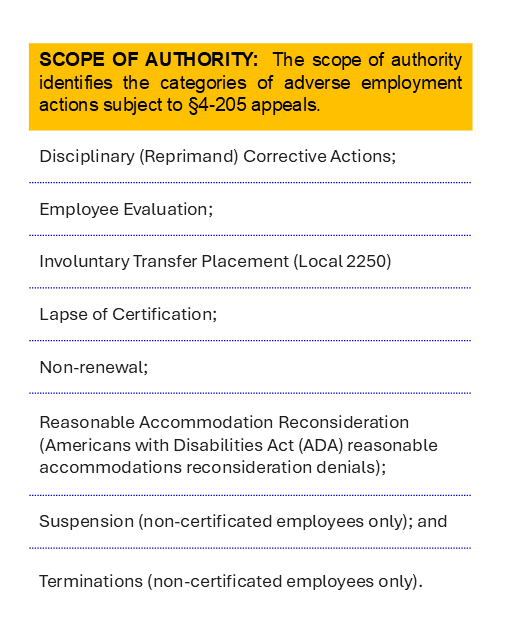
Certain employees who are subject to an adverse employment action may, within ten (10) business days of notice of such action, appeal the decision to the Office of Appeals and Hearing.
DEFINITIONS:
Adverse Action: An action taken by PGCPS that negatively affects an employee's terms, conditions, or privileges or employment.
Appellant: Refers to the party (employee) who is appealing.
Burden of Proof: The employee (appellant) has the burden of proof by a preponderance of the evidence(COMAR 13A.01.05.06D). This burden requires sufficient credible evidence that their claim is true.
Determination: The final outcome issued on behalf of the Superintendent whereby the decision may be upheld, modified or reversed.
On the Record Review: The Office of Appeals and Hearings (OAH) will conduct a review of the appeal on the written record unless there is a compelling reason to conduct a virtual hearing as determined by OAH. A hearing is not conducted for a determination issued on the written record. “On the written record” is a process where OAH will review information provided by the appellant and documentation obtained through a formal records request provided by parties responsible for issuing the decision on appeal.
Respondent: The party responsible for rendering the decision on appeal may include the Chief Human Resources Officer, Chief, Associate Superintendent, Supervisor or Principal.
GROUNDS FOR AN APPEAL:
This is the reason provided by the employee to justify the request for a review of the adverse employment decision. The Code of Maryland Regulations (COMAR) stipulates the grounds for which an employee may appeal an adverse employment action. The grounds for appeal differ based upon the employment status of the employee.
Executive, At-will, Probationary, Substitute,Temporary Positions, and Non-Tenured Teachers:
An adverse employment action may be taken against this class of employees for any reason, or for no reason at all, whether the decision is perceived as fair or unfair, provided the decision was not illegal, discriminatory or against Maryland public policy, or otherwise unlawful. See Charlene King v. Baltimore City Board of School Commissioners (2014), see also Stafford v. Baltimore City Bd. of School Comm’rs, MSBE Op. No. 20-37 (2020).
Permanent Employees (certificated and non-certificated) and Tenured Teachers:
According to COMAR § 4-205(c)(3), employees in this class may appeal an adverse employment action it the decision is arbitrary, unreasonable, or illegal.
- Arbitrary is defined as a decision made without evidence or adherence to established policies and procedures;
- Unreasonable is defined as a decision lacking a rational connection between the facts and the outcome, and/or
- Illegal, meaning the decision was discriminatory, or against Maryland public policy.